Tame the Monkey Mind
Celebrating National Monkey Day!
Tame the Monkey Mind – if you’ve tried meditating, especially as a beginner, you will know how your mind seems to bounce everywhere with thoughts.
It’s a similar challenge for children trying to meditate and who struggle to stay focussed.
Using the idea of a monkey jumping from tree to tree—restless, distracted, and hard to control it can help children understand what is happening and why – we call it the ‘monkey mind’.
Meditation is an excellent way to tame the monkey mind, however it offers more than simply calming the mind—our bodies and voices can mindfully release overwhelm, especially in kids. Using sound when teaching kids meditation, is a fantastic meditation tool. Deliberately, mindfully making noise, we can free up stuck energy and reduce overwhelm. Especially around the throat chakra, which is an energy centre where kids (and adults!) can store difficult feelings. It shows up when we hold back feelings or struggle to say how we feel.
As the festive period can be stressful, it’s the perfect time to practise letting go so that everyone comes into balance. In this blog, we offer monkey-inspired suggestions using movement, breath, and sound to help everyone balance those busy minds. Plus it is national monkey day this sunday!
The Monkey Mind & Why It’s So Hard to Sit Still
When we sit down to meditate, it’s easy to get frustrated when the mind is active.
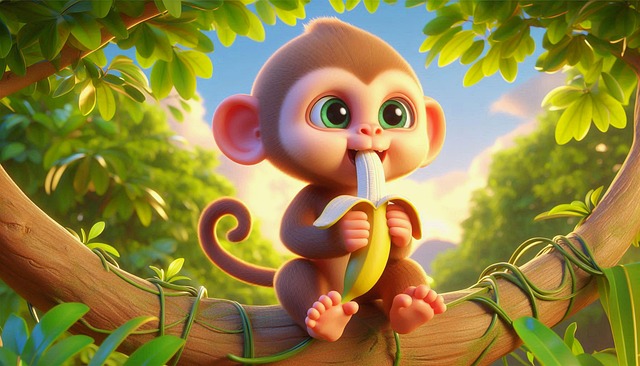
Thoughts jump around, distractions pop up, and we wonder if we’re doing it “wrong.” It’s like trying to tame a monkey who is used to the freedom of ‘jumping from branch to branch’.
This is what’s known as the monkey mind. It’s the restless, noisy part of our minds that keeps consistently processing, but in meditation, it can feel (initially) very distracting. But it is totally natural – especially for beginners.
What’s interesting is that when kids (or anyone) have a hard time expressing feelings, those emotions can get stuck in the body and the mind can become ‘busier’. The throat chakra, the energy center for communication and self-expression, becomes the placeholder for unexpressed feelings. If kids feel shy, frustrated, or even excited and are unsure how to express it, their energy becomes stuck in this area, and it become more challenging for them to calm down or share how they feel. Using mindful sounds can help.
Monkey Mind Meets the Power of Sound
It may feel counterintuitive to the idea of meditation (usually viewed as a silent practice) to encourage children to be noisey.
But it can help release all that pent-up energy and bring some calm to the monkey mind. And it offers a simple outlet for kids when they’re struggling to express their true feelings.
Here are some playful ways to use sound and movement to help everyone release energy and bring balance to the mind, body, and throat chakra.
1. Monkey Roars (Throat Chakra Release)
Start by sitting comfortably and inviting children to close their eyes. Take a few deep breaths, imagining the monkey mind settling down. Now, guide them to let out a loud “RAWR!” like a playful monkey! (You might have to demonstrate to help them know what to do). It can be in a low, deep voice or a high, silly one—totally up to you and your kids!)
Repeat this a few times, really letting the sound come from the belly. Feel the vibration in the throat and chest as everyone roars. Let voices get louder and freer with each sound.
After every 3 or 4 sounds, it’s important to guide kids to notice the opposite – silence. Maybe their hearts are beating faster, ears buzzing? Where has their mind gone (is the monkey still swinging from branch to branch, or has it settled in a tree for the moment?)
2. Monkey Swinging (Movement + Breath + Sound)
Make sure there’s enough room for everyone to stretch out. Stand tall and guide your kids to imagine they are a monkey swinging on a branch. As they breathe in, stretch their arms wide like you’re reaching for a branch. As they breathe out, they make a loud “whoo-hoo!” sound, swaying side to side.
3. Jungle Drum Chant (Sound Vibration for Focus)
Find a rhythm to tap on the knees, feet, or even use a drum or any object to create a beat. Start with a slow, steady rhythm—something that mimics the jungle’s calming sounds. As you tap, chant a simple phrase like “I am calm” or “I am strong” to the beat. Invite your kids to tap or beat along. Speed it up, then slow it down – after 60s, stop, and everyone has to notice what it’s like when there is no beat/sound.
4. Monkey Mind Meditation with Sound
Sit quietly and imagine the thoughts are like monkeys jumping from tree to tree. Take your kids attention to their breath, and guide them to let out a soft “oo-oo” sound, like a monkey calling to a friend. Repeat this so they can notice their breath, rather than thoughts – encourage them to make the sound as long as possible (this activates the rest and digest within the nervous system to calm things down).
These suggestions combine movement, breath, and sound to release excess energy and bring attention to the body. It helps children practice expressing their emotions with sound rather than bottling them up (and develop into a tantrum!)
As you teach them to practise, don’t be surprised if they giggle and laugh! This is normal and can often release stress/pent-up emotion in a different way. It’s still an opportunity for a mindful moment; guide them to notice breath/body and sound as they giggle.
Fun Monkey Facts to Celebrate National Monkey Day
While you are teaching kids meditation to calm the monkey mind, use these fun facts to teach them about monkeys:
- Monkeys are found all over the world! There are over 260 species, and they live in Africa, Asia, and South America. From tiny pygmy marmosets to massive mandrills, monkeys come in all shapes and sizes.
- Old World vs. New World: Monkeys are split into two main groups—Old World monkeys, found in Africa and Asia, and New World monkeys, found in South America.
- Monkey Zodiac: Monkeys are part of the Chinese Zodiac. Every 12 years, a different type of monkey takes the spotlight. In 2028, it will be the Earth Monkey.
Remember: the more you practice, the easier it becomes to calm that monkey mind and find peace, one playful, mindful sound at a time.
Curious to know more?
If you are interested in finding out more about teaching your children and teens mindful skills to tame the monkey mind:
(Image by Syaibatul Hamdi from Pixabay)