If you’re overdue for dental care, I want to talk to you directly.
Maybe you’re several years (or even decades) behind on cleanings. Maybe you’re ignoring tooth pain. Haven’t flossed in ages.
If that’s you, it’s important to me that you know:
You’re not lazy and you are not a failure.
And to the dentists and hygienists reading this—you know this too.
Our job isn’t just fixing what’s broken. The Latin root of doctor means teacher. We’re teachers, coaches, and even students of human behavior.
We work inside the most personal space of the human body, and what happens there is never only physical.
It’s fear, habit, trust, shame—all playing out in a tiny space inside our heads that we’re wired to protect because it affects our breathing.
In many ways, our real craft is helping people find the courage to start again.
People don’t skip visits because they don’t care.
They skip because they’re tired, anxious, burned out, or ashamed.
I promise you this: your dentist and hygienist aren’t judging you. They want you to come in. That’s their only goal.
I’ve sat with thousands of patients who swore their teeth were “beyond repair.”
People who thought they were the worst case I’d ever seen. Trust me—I’ve seen it all.
Broken crowns, years of decay, complete neglect, recovering addicts, people in recovery, CEOs and new parents and medical students running themselves ragged…
And every single time, I’ve said the same thing: “You’re here now. That’s what matters.”
Small steps on the hard days
- Too exhausted to brush? Keep a toothbrush by your bed. No toothpaste and no sink required! I call this a “dry brush” and it’s all you need to disorganize plaque at the end of the day.
- Floss one tooth. Yes—one. The psychology here is that once you feel how clean that single spot is, you’ll want to do another. Then another.
- Forget to change your brush head? Put it on auto-delivery so you never think about it again.
- Overwhelmed? Book a cleaning and let someone else take care of you. All you have to do is show up.
Something is always better than nothing.
Beyond brushing and flossing, there are a few other tools that can make a real difference:
Xylitol gum. Science shows xylitol is sweet, but it doesn’t act like sugar in the body. The bacteria in your mouth can’t metabolize it, so it tricks cavity-causing bacteria into starving themselves. Chewing xylitol gum after meals also boosts saliva flow, which helps neutralize acids and keep your mouth’s pH balanced. I keep a pack in my car and another on my desk—it’s one of the easiest, evidence-backed wins for your mouth after snacks.
Creatine. Research shows creatine can sharpen working memory, and even support mood—especially when you’re stressed or sleep-deprived. (Any new parents out there?!) One study showed it helped people think clearly after a night of poor sleep. Personally, I’ve been following the rule of thumb: 5 grams for the brain, 5 grams for muscle. My wife doesn’t tolerate creatine well, so keep in mind, it’s not for everyone. But for me, the benefits have been tremendous. This is the one I take every day.
Magnesium: Clinical trials show magnesium helps people fall asleep faster and sleep more deeply. When patients sleep better, they grind and clench less at night—which spares the teeth and jaw. Magnesium also plays a direct role in supporting saliva production and quality, and saliva is your mouth’s natural defense system—it buffers acids, delivers calcium and phosphate to rebuild enamel, and keeps cavity-causing bacteria in check—especially important when brushing and flossing aren’t happening, or even when we’re under high stress (a new job, a new baby, the death of a loved one, care giving, just to name a few examples…) I take this one.
If anxiety keeps you away
Please know you’re not alone. I’ve reassured countless patients who have said to me, “Please don’t judge me.” My answer is always the same: “I’m not judging. I’m glad you’re here.”
And if sitting in the chair feels impossible, know that you have options.
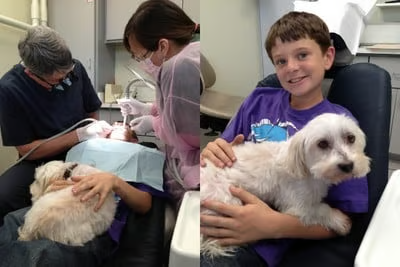
Some dental offices offer therapy dogs, blankets, or noise-canceling headphones to help calm anxiety.
Even a photo of a dog can lower stress—seriously, there’s research on this. If your office doesn’t offer these things, ask. The right team will find ways to make you comfortable.
Rebuilding trust with yourself
- Keep floss picks in your car’s cupholder.
- Pair brushing with a favorite podcast or calming music – something you look forward to. Scroll Instagram while you brush and floss—this is possible with a flossing stick!
- Too overwhelmed? Do half a routine, or even one quarter of a routine. Brush without toothpaste. Swish with water or green tea. (I love these little tea packets which are oral microbiome friendly and super portable.) Start where you are.
- Ask your dental team to break care into steps. You don’t have to fix everything at once.
Remember: progress, not perfection.
You’re not “bad at self-care.” You’re living in a world that drains you. Sometimes brushing one tooth is the bravest thing you’ll do that day. Sometimes lying back in the dental chair is the bravest thing you’ll do all year!
And that’s enough.
I’m rooting for you.
– Dr. B

P.S. P.S. If your dentist or hygienist ever makes you feel ashamed, you’re in the wrong place. That’s not the right practice for you. You deserve to walk into any office, no matter how long it’s been, and feel welcomed, not judged.
And If a dentist hands you a long, expensive treatment plan on day one, it’s okay to pause and say, “Can we start small? Maybe just do one thing first so I can get a feel for your work and the office?” A good dentist will say, “Of course.” If they push back, get up, thank them, and move on. Don’t look back.
There are plenty of great dentists out there who will earn your trust step by step. Find the one who listens, explains, and wants to build a long-term partnership with you. That’s the kind of relationship that changes your health for life. Two great places to look, with free worldwide directories, are AADSM.org and the functional dentist directory on my website.
Below, pictured, is Remy, the therapy dog who worked alongside me back when I was in private practice. He helped so many patients with exactly what we’ve talked about in this newsletter—fear, anxiety, and finding the courage to come back. He even made the news. May he rest in peace. He’ll always be part of the story of this work.